
 English
 Español
 русский
 عربى
عربى
Home / News / Industry News / How to Select the Appropriate KCB Gear Pump Model Based on Engineering Requirements?
How to Select the Appropriate KCB Gear Pump Model Based on Engineering Requirements?
Precise Selection is the Cornerstone of Efficient Industrial Fluid System Operation
In fields such as industrial lubrication, fuel transfer, hydraulic fluid supply, and chemical metering, KCB gear pumps are widely used as power components due to their compact structure, reliable operation, simple maintenance, and high cost-effectiveness. However, faced with a series of models ranging from KCB-18.3 to KCB-483.3 with different displacements, pressure ratings, and material configurations, incorrect selection can lead to insufficient flow, pressure fluctuations, increased wear, or even system downtime. This article aims to provide a clear, actionable selection framework to help engineers and procurement managers precisely match the most suitable KCB gear pump model based on actual engineering requirements.
Step 1: Define Core Performance Parameters – The Foundation of Selection
Selection must start from the following three key system parameters:
- Flow Requirement: Determine the required volumetric flow rate for the system, typically in liters per minute (L/min) or cubic meters per hour (m³/h). The pump's displacement (volume delivered per revolution) and drive speed together determine the output flow.
- Key Question: Does the system require constant or variable flow? Are there minimum/maximum flow limits?
- Working Pressure: Clarify the maximum system pressure the pump needs to overcome, in Bar or Megapascals (MPa). The KCB series has distinct pressure classifications (e.g., low-pressure transfer type vs. high-pressure fuel type). Overpressure operation will severely shorten seal life and damage gear shafts.
- Key Question: What is the system's steady-state pressure? Do pressure peaks or shocks exist?
- Media Characteristics: This is key to determining pump material and construction.
- Viscosity Range: KCB gear pumps are particularly suitable for medium to high viscosity fluids like lubricating oil, asphalt, and resin. The pump's clearance design is optimized for a specific viscosity range. Pumping low-viscosity media (like water) may lead to reduced efficiency or require special configurations.
- Corrosivity and Lubricity: Is the fluid corrosive, contain abrasives, or have poor lubricity? This directly determines the material selection for gears, pump body, and shaft seals.
Step 2: Material and Configuration Selection – Matching Media and Environment
Based on the core parameters, configurations need to be refined according to fluid properties and installation environment:
- Pump Body Material:
- Cast Iron Type: Economical and practical, suitable for non-corrosive lubricating oils, light fuels, etc.
- Stainless Steel Type (e.g., 304/316): Used for corrosive media (some chemicals, solvents) or occasions with sanitary requirements like food and pharmaceuticals.
- Sealing Options:
- Packed Seal: Good temperature resistance, allows minor adjustments, suitable for non-hazardous media where minimal leakage is acceptable.
- Mechanical Seal: Achieves zero leakage, suitable for volatile, expensive, or hazardous fluids.
- Drive Method: Choose as needed: direct motor coupling, belt drive, or flange mounting.
Step 3: Understanding Key Engineering Differences in KCB Model Numbers
The "KCB" suffix and series designation correspond to different performance emphases:
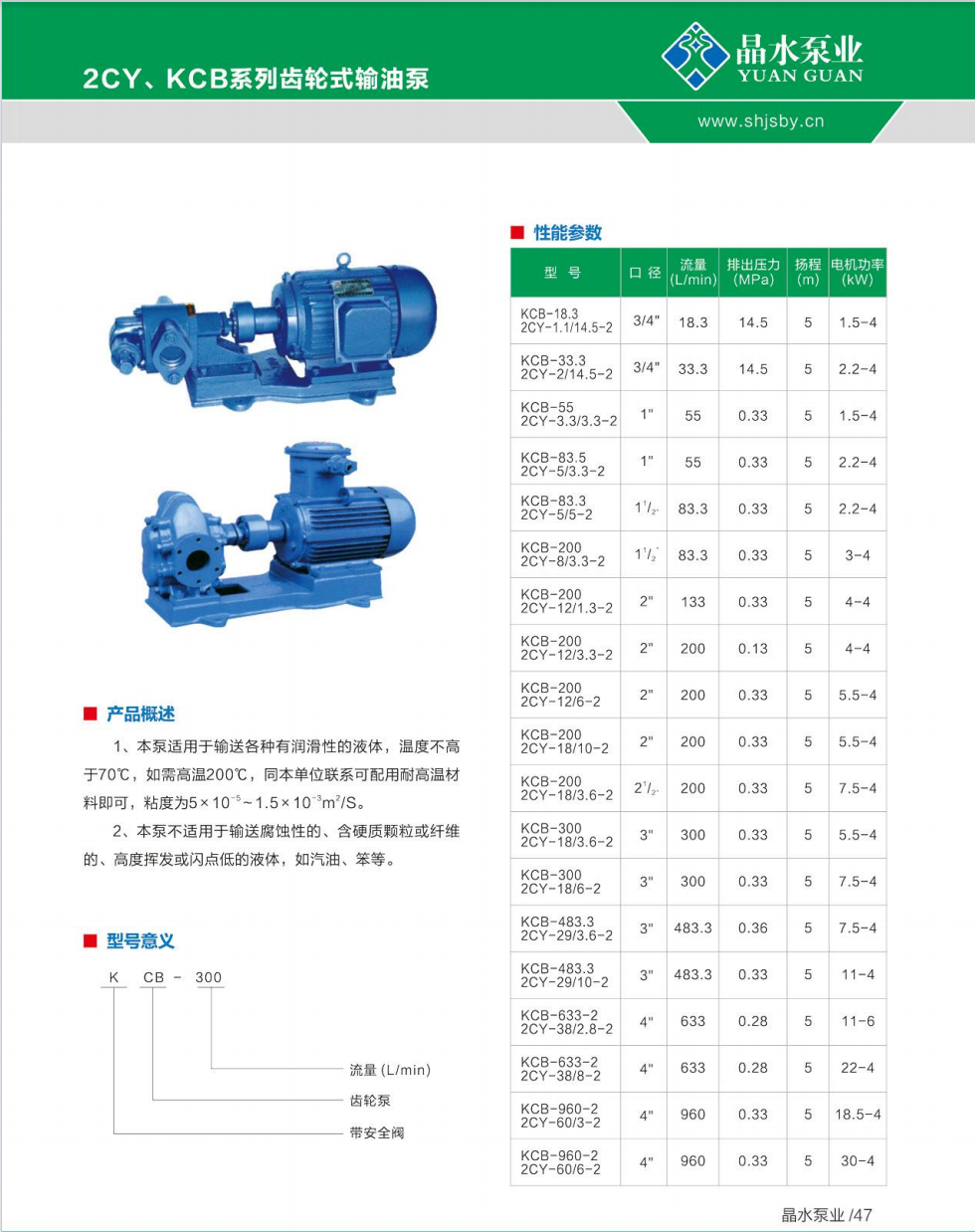
- Displacement Series: The model numbers (e.g., KCB-18.3, KCB-483.3) represent specific displacements. These must be combined with drive speed to meet flow requirements.
- Pressure Rating: There are low-pressure series (e.g., 1.45 MPa) and high-pressure series (e.g., 3.3 MPa), corresponding to different bearing and housing structures.
- Special Adaptations: Some models can integrate safety valves, heating jackets, or special coatings to adapt to high temperatures, easy-to-solidify, or sensitive media.
Step 4: Selection Decision Framework – Practical Action Checklist
Complete the selection systematically by following these steps:
- Collect Data: Record the fluid's exact name, viscosity at working temperature, corrosive components, and operating temperature range.
- Calculate System Requirements: Confirm the required Flow (Q) and Pressure (P), and add a 10-15% safety margin.
- Consult Performance Curves: On the performance curve chart provided by the manufacturer, locate the required (Q, P) point to ensure it falls within the target model's efficient operating zone.
- Specify Material and Seal: Based on the media analysis results, finalize the pump body material and seal type.
- Confirm Accessories and Integration Needs: Assess whether safety valves, inlet/outlet flange adapters, or complete skid-mounted systems are needed.
Conclusion: Invest in Precise Selection for Long-Term Value
Selecting a KCB gear pump is a systematic task that balances engineering technical parameters with actual working conditions. There is no "universally best" model, only the model "most suitable for the specific application". Correct selection not only ensures stable and efficient system operation but also significantly reduces energy consumption, maintenance costs, and total lifecycle cost.
The Value of Support from Professional Manufacturers
When facing complex working conditions, cooperation with manufacturers possessing deep engineering experience is crucial. As a source manufacturer holding CE and ISO certifications, we provide precise selection support, material customization, and performance testing services for the full range of KCB gear pumps. We are committed to helping customers go beyond simple product procurement to achieve reliable fluid solutions deeply integrated with the overall industrial process.
Related products
Copyright © JINGSHUI PUMP (SHANGHAI) CO., LTD. All Rights Reserved.
Custom Water Supply/Drainage, Water Treatment, Fire Pump Systems Manufacturers
